
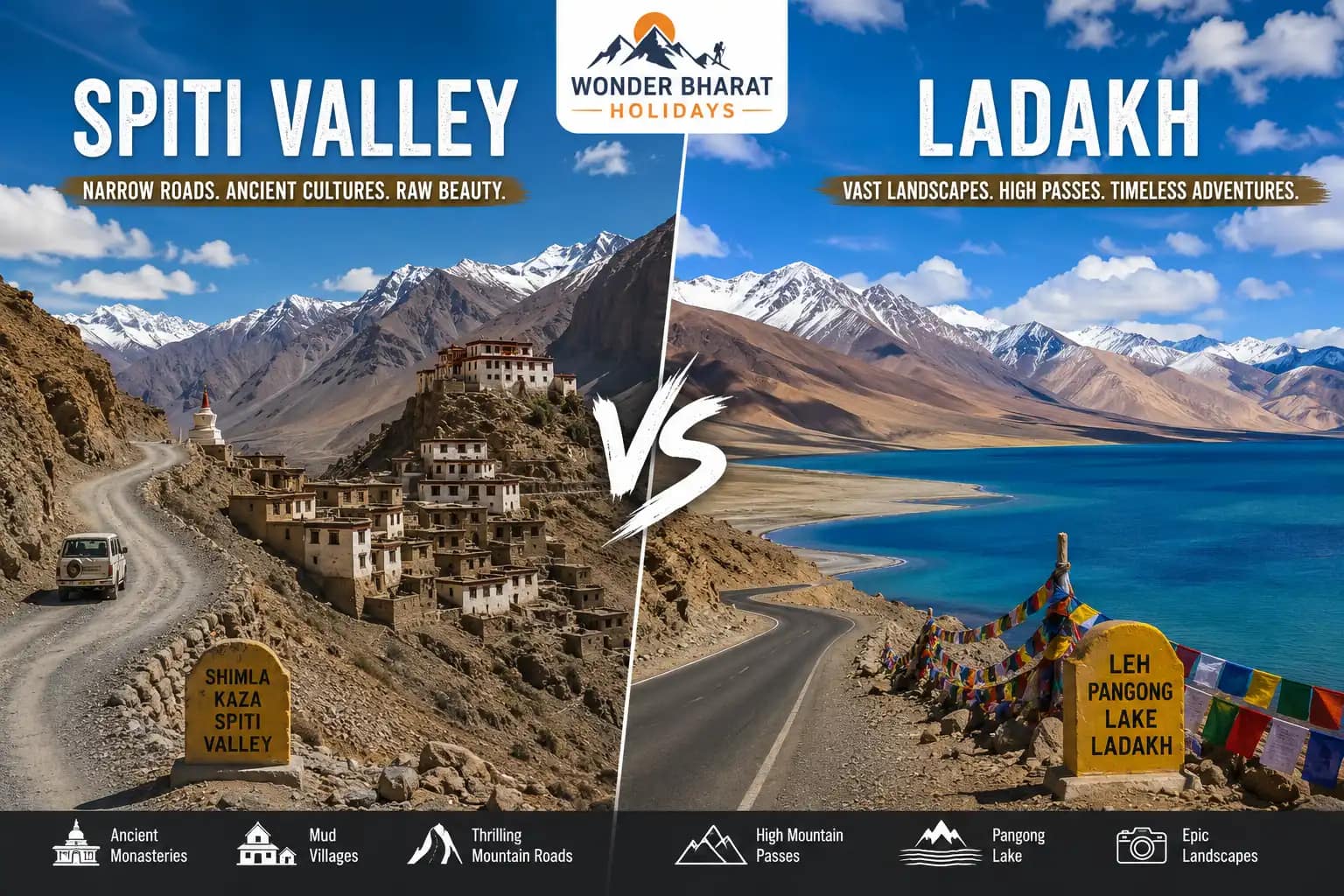
Spiti Valley is better for road-trip travellers who want gradual acclimatization, lower daily costs and village-based cultural experiences. Ladakh is better for travellers who want easier air access, larger high-altitude landscapes, established tourism infrastructure and landmarks such as Nubra Valley and Pangong Lake. First-time high-altitude travellers should generally choose the Shimla–Spiti route or allocate at least two acclimatization days after flying into Leh.
Spiti Valley vs Ladakh: Quick comparison
| Comparison factor | Spiti Valley | Ladakh |
|---|---|---|
| Budget trip cost | ₹20,000–₹30,000 per person for 7–9 days from Delhi | ₹25,000–₹40,000 per person for 6–8 days, excluding expensive last-minute flights |
| Mid-range trip cost | ₹32,000–₹50,000 per person | ₹42,000–₹70,000 per person |
| Luxury trip cost | ₹65,000–₹1,00,000+ per person | ₹80,000–₹1,50,000+ per person |
| Typical starting altitude | Shimla: approximately 2,200 metres | Leh: approximately 3,500 metres when arriving by air |
| Typical sleeping altitude | Kaza: approximately 3,650 metres | Leh: approximately 3,500 metres |
| Maximum common road-trip altitude | Kunzum Pass: approximately 4,550 metres | Umling La: above 5,700 metres; Khardung La and Chang La are also above 5,300 metres |
| Acclimatization pattern | Gradual when entering through Shimla, Kinnaur and Tabo | Abrupt when flying directly into Leh |
| Road conditions | Narrow roads, rockfall zones, broken surfaces and water crossings | Longer distances, wider highways in places, rough pass sections and remote stretches |
| Best time to visit | June to September for the full circuit; May to October through Shimla, subject to road conditions | May to September for road trips; April to October for fly-in itineraries, subject to weather |
| Typical trip duration | 7–10 days | 6–10 days |
| Best suited for | Slow travel, monasteries, villages, road journeys and budget groups | Lakes, high passes, motorbike trips, photography and premium expeditions |
Cost note: These estimates assume twin or triple sharing. Flight fares, private SUVs, premium camps and solo travel can increase the total substantially.
Is Spiti cheaper than Ladakh?
Yes, Spiti is usually cheaper than Ladakh for travellers starting from Delhi or Chandigarh. Spiti does not require a flight, and accommodation in places such as Tabo, Kaza, Kalpa and Sangla is often available through locally operated homestays.
Ladakh becomes more expensive because of flights, union-regulated taxi rates, long sightseeing circuits and the logistics of transporting supplies into remote areas. A private Leh–Nubra–Pangong circuit can form a large part of the total trip cost.
Spiti, however, is not automatically cheap. A private vehicle travelling for eight or nine days, premium hotels in Kaza and exclusive Chandratal arrangements can bring its cost close to that of Ladakh.
Approximate daily cost in Spiti Valley
| Expense | Budget traveller | Mid-range traveller | Premium traveller |
|---|---|---|---|
| Stay per person | ₹800–₹1,500 | ₹1,800–₹3,500 | ₹4,500–₹9,000+ |
| Food per person | ₹700–₹1,200 | ₹1,200–₹2,000 | ₹2,000–₹3,500 |
| Transport per person | ₹1,200–₹2,500 in a group | ₹2,500–₹4,500 | ₹5,000–₹9,000+ |
| Permits and local fees | Usually minimal for Indian citizens | Usually minimal | Route-dependent |
| Estimated daily total | ₹2,700–₹5,200 | ₹5,500–₹10,000 | ₹11,500–₹21,500+ |
Indian citizens generally do not need a Protected Area Permit for the standard Spiti circuit. Foreign nationals may require a permit for notified protected areas in Kinnaur and Spiti.
Wonder Bharat Pro-Tip: Do not compare packages only by the hotel category. Check whether the price includes Chandratal transport, driver allowance, tolls, local sightseeing and pickup from Delhi or Chandigarh.
Approximate daily cost in Ladakh
| Expense | Budget traveller | Mid-range traveller | Premium traveller |
|---|---|---|---|
| Stay per person | ₹1,000–₹1,800 | ₹2,200–₹4,500 | ₹6,000–₹15,000+ |
| Food per person | ₹800–₹1,400 | ₹1,500–₹2,500 | ₹2,500–₹5,000 |
| Shared or allocated transport | ₹1,500–₹3,000 | ₹3,000–₹6,000 | ₹7,000–₹15,000+ |
| Environmental and permit-related fees | Approximately ₹450–₹1,000 | Approximately ₹450–₹1,000 | Approximately ₹450–₹1,000 |
| Estimated daily total | ₹3,750–₹7,200 | ₹7,150–₹14,000 | ₹15,950–₹36,000+ |
The official Leh tourism portal currently allows domestic travellers to make the required online payment and carry the payment slip to relevant checkpoints. Rules, permitted routes and charges should always be reconfirmed before departure.
Wonder Bharat Pro-Tip: On the Nubra–Pangong route through the Shyok River corridor, avoid planning by distance alone. Water flow, road repairs and convoy movement can change travel time considerably.
Which destination is safer for acclimatization?
Spiti through Shimla is usually easier for acclimatization than flying directly into Leh. The difference is not that Spiti is low altitude; many Spiti villages are as high as or higher than Leh. The advantage comes from the rate of ascent.
A Shimla–Kinnaur–Spiti itinerary gradually moves from approximately 2,200 metres in Shimla to around 2,960 metres in Kalpa, 3,280 metres in Tabo and approximately 3,650 metres in Kaza. The body receives several nights to adapt before sleeping at the highest points.
A flight to Leh moves a traveller from near sea level to approximately 3,500 metres in a few hours. This rapid reduction in available oxygen raises the probability of Acute Mountain Sickness.

What is AMS and why does the route matter?
Acute Mountain Sickness, or AMS, is the body’s response to reduced oxygen pressure at altitude. Common symptoms include headache, nausea, reduced appetite, disturbed sleep, dizziness and unusual fatigue.
At around 3,050 metres, inspired oxygen pressure is substantially lower than at sea level. Physical fitness does not prevent AMS; a fit traveller can still develop symptoms after ascending too quickly.
Once above approximately 3,000 metres, medical guidance generally recommends limiting increases in sleeping altitude and including acclimatization days. Travellers should avoid heavy exercise and alcohol during the first 24–48 hours after a rapid ascent.
Shimla–Spiti gradual ascent
A responsible Spiti itinerary normally includes overnight stops in Shimla or Narkanda, Sangla or Kalpa, and Tabo before reaching Kaza. This does not eliminate AMS, but it reduces the abruptness of the altitude gain.
The risk can increase when travellers rush from Manali directly to Kaza. That route crosses higher terrain rapidly and may include Kunzum Pass before the body has adapted.
Flying directly into Leh
The first day in Leh should be treated as an acclimatization day, not a sightseeing day. Travellers should rest, hydrate normally, eat light meals and avoid climbing to high passes immediately after landing.
A second night in Leh is advisable before travelling to Nubra Valley, especially for first-time high-altitude visitors. Preventive medication such as acetazolamide should be discussed with a qualified doctor rather than taken casually.
Wonder Bharat Pro-Tip: Do not schedule Khardung La, Chang La or Pangong Lake on Day 1 after landing in Leh. Oxygen cylinders in a vehicle are emergency support, not a substitute for acclimatization.
Severe breathlessness at rest, confusion, loss of coordination, persistent vomiting or a wet cough can indicate a medical emergency. The correct response is urgent medical assessment and, when advised, descent.
Spiti Full Circuit Itinerary is Here
Ladakh Trip Itinerary is Here
Which has better roads: Spiti or Ladakh?
Neither destination should be treated as a normal highway holiday.
Spiti roads are commonly narrow, exposed and vulnerable to rockfall. Sections around Kinnaur, Malling Nallah, Pin Valley, Kunzum Pass and the Batal–Chandratal route may contain broken surfaces or water crossings.
Ladakh has longer stretches of surfaced road, particularly around Leh, but high passes and remote routes remain demanding. Sand, loose gravel, cold-start problems, stream crossings and long distances without repair facilities are common.
Wonder Bharat Pro-Tip: Near Chicham Bridge, avoid stopping a large vehicle in the centre of the road for photographs. Use a safe lay-by and allow local traffic to pass.
For both regions, a high-ground-clearance SUV is more suitable than a low sedan. Motorcyclists should carry puncture equipment, layered riding gear and sufficient fuel for remote sectors.
Which destination has the better itinerary?
Recommended 8-day Spiti Valley itinerary
Day 1: Delhi to Shimla or Narkanda
Day 2: Narkanda to Sangla or Chitkul
Day 3: Sangla to Kalpa
Day 4: Kalpa to Tabo via Nako and Sumdo
Day 5: Tabo to Kaza via Dhankar Monastery
Day 6: Kaza local circuit: Key Monastery, Kibber and Chicham Bridge
Day 7: Langza, Hikkim and Komic
Day 8: Return towards Manali or begin the return through Kinnaur
For a full circuit with Chandratal, allocate nine or ten days. Buffer time is important because the Manali–Kaza sector can be affected by snow, landslides and water crossings.

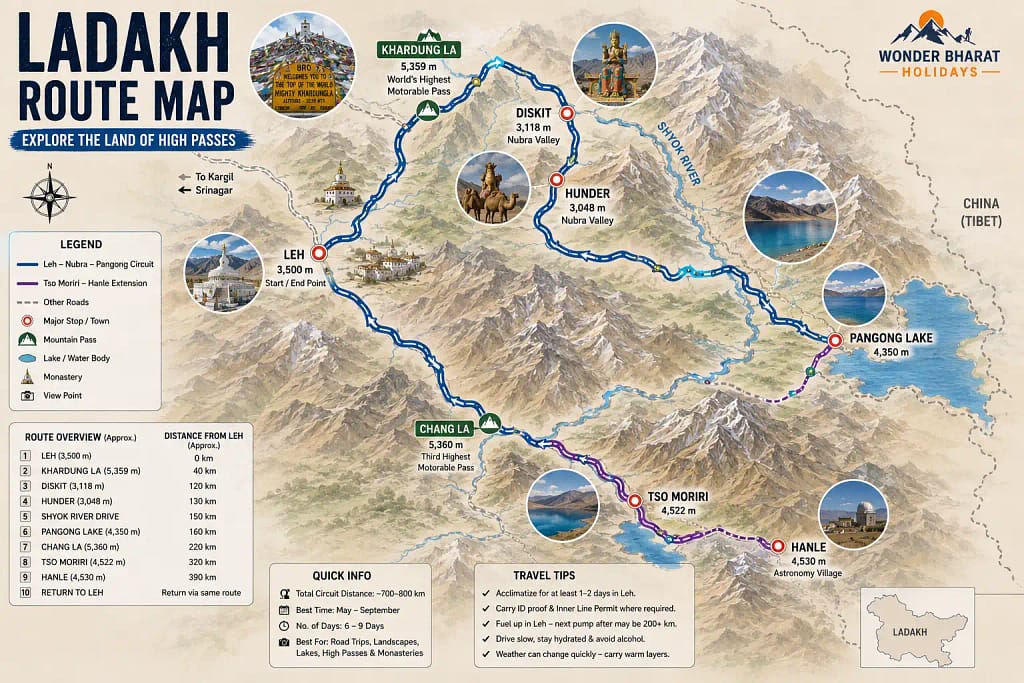
Recommended 7-day Ladakh itinerary
Day 1: Arrive in Leh and rest
Day 2: Leh acclimatization and local sightseeing
Day 3: Leh to Nubra Valley via Khardung La
Day 4: Nubra Valley to Pangong Lake via Shyok
Day 5: Pangong Lake to Leh via Chang La
Day 6: Leh local monasteries or Sham Valley
Day 7: Departure
Add two days for Tso Moriri, Hanle or a slower Nubra stay. Avoid combining too many remote destinations merely to increase the number of places covered.
Is Spiti or Ladakh better for families?
Spiti is better for families who can tolerate long road journeys and prefer gradual ascent. The Shimla approach allows the itinerary to build altitude over several days.
Ladakh is better for families who want to reduce total travel days, but the first 48 hours in Leh must remain light. Families with elderly travellers, young children or people with heart and lung conditions should seek medical advice before either trip.
Comfort also depends on the route. Spiti has fewer premium hotels outside Kaza, while Ladakh offers a wider range of established hotels in Leh but more basic facilities near remote lakes.
Is Spiti or Ladakh better for a bike trip?
Choose Spiti for a technically varied circuit with narrow roads, mixed surfaces, villages and frequent changes in terrain.
Choose Ladakh for long-distance riding, high passes, broad valleys and iconic routes. However, Ladakh’s distances, wind exposure and fuel planning make it a more logistics-heavy expedition.
Wonder Bharat Pro-Tip: Carry reserve fuel only in approved, secure containers. In Spiti, refuel whenever reliable fuel is available around Reckong Peo or Kaza. In Ladakh, confirm fuel availability before sectors such as Hanle, Tso Moriri or remote Changthang routes.
What is the final verdict: Spiti Valley or Ladakh?
Choose Spiti Valley when your priorities are lower overall cost, gradual acclimatization, monasteries, village interaction and a continuous road journey.
Choose Ladakh when your priorities are air connectivity, high-altitude lakes, wide landscapes, major mountain passes and more developed tourism services around a central base in Leh.
For a first Himalayan expedition, the Shimla–Spiti route is the more controlled introduction to altitude. For travellers already comfortable above 3,500 metres, Ladakh provides more route combinations and premium travel options.
At Wonder Bharat Holidays, we recommend comparing the destinations by ascent profile, transport model and number of high-altitude sleeping nights, not only by photographs or package price.
Frequently asked questions
1. Is Spiti Valley cheaper than Ladakh?
Yes. A shared Spiti trip generally costs less because it does not require a flight and has lower-cost homestay options. Ladakh taxi circuits and airfares usually increase the total.
2. Which is better for first-time high-altitude travellers?
Spiti through Shimla is generally better because the route gains altitude gradually. A fly-in Ladakh trip requires at least one full rest day and preferably two nights in Leh before crossing high passes.
3. How many days are enough for Spiti and Ladakh?
Plan eight to ten days for Spiti and seven to nine days for Ladakh. Shorter itineraries may compromise acclimatization or require excessive daily driving.
4. Do Indian tourists need permits for Spiti or Ladakh?
Indian citizens generally do not need a Protected Area Permit for normal Spiti tourism. In Ladakh, travellers visiting notified areas must complete the required tourism payment or permit process and carry the documentation requested at checkpoints.
5. Can Spiti and Ladakh be covered in one trip?
Yes, but a combined Trans-Himalayan expedition normally requires 14–20 days, dependable vehicles and careful route planning. Road openings between Himachal and Ladakh are seasonal, so buffer days are essential.